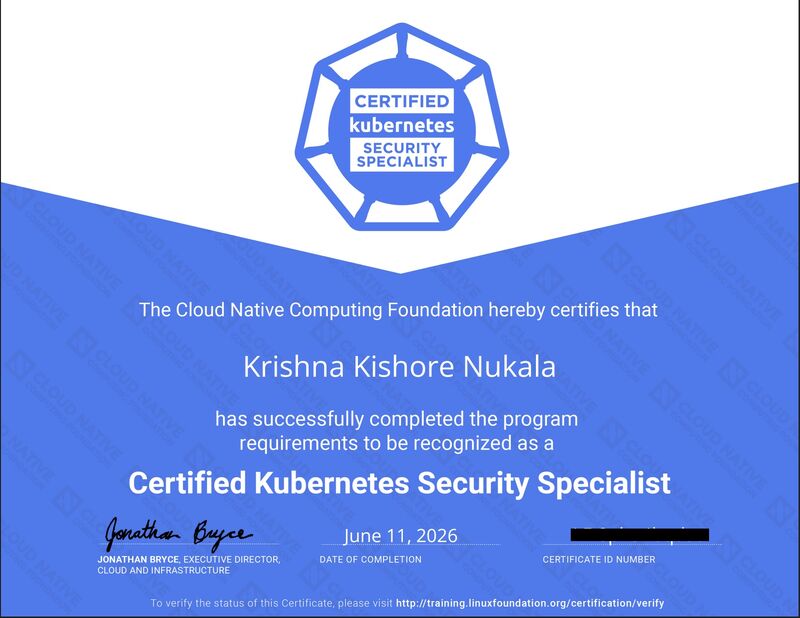
Certified Kubernetes Application Developer (CKAD) Program Practice Test
Linux-Foundation CKAD Exam Dumps Questions
Prepare and Pass Your CKAD Exam with Confidence. AllExamTopics offers updated exam questions and answers for Certified Kubernetes Application Developer (CKAD) Program, along with easy-to-follow study material based on real exam questions and scenarios. Practice smarter with high-quality practice questions to improve accuracy, reduce exam stress, and increase your chances to pass on your first attempt.
48 Questions & Answers with Explanation
Update Date : Jul 16, 2026
PDF + Test Engine
$65 $130
Test Engine
$55 $110
PDF Only
$45 $90
Success GalleryReal results from real candidates who achieved their certification goals.
CKAD - Certified Kubernetes Application Developer (CKAD) Program Practice Exam Material | AllExamTopics
Get fully prepared for the CKAD – Certified Kubernetes Application Developer (CKAD) Program certification exam with AllExamTopics’ trusted passing material. We provide CKAD real exam questions answers, updated study material, and powerful online practice material to help you pass your exam on the first attempt.
Our Certified Kubernetes Application Developer (CKAD) Program exam study material is designed for both beginners and experienced professionals who want a reliable, exam-focused preparation solution with a 100% passing and money-back guarantee.
Why Choose AllExamTopics for CKAD Exam Preparation?
At AllExamTopics, we focus on real results, not just theory. Our CKAD practice material is built using real exam patterns and continuously updated based on the latest exam changes.
100% Passing Guarantee
Money-Back Guarantee
Real Exam Questions Answers
Updated Passing Material
Free Practice Questions Answers
Online Practice Material
Instant Access After Purchase
We help you prepare smarter, not harder.
What’s Included in Our CKAD Exam Questions PDF?
Our CKAD practice exam material covers all official exam objectives and provides complete preparation in one place.
1. CKAD Real Exam Questions Answers
Based on recent and actual exam scenarios
Covers all important and frequently asked questions
Helps you understand real exam patterns
2. Practice Material for Self-Assessment
High-quality practice questions answers
Helps identify weak areas before the real exam
Improves accuracy and speed
3. Online Practice Material
Real exam-like interface
Accessible on desktop, tablet and mobile
Practice anytime, anywhere
4. Free CKAD Practice Questions Answers
Try before you buy
Evaluate our CKAD dumps quality
Understand the exam format
5. Comprehensive Study Material
Clear explanations for each topic
Easy-to-understand answers
Designed to strengthen both concepts and confidence
Real CKAD Exam Questions You Can Trust
Study only what matters. Our CKAD Practice exam questions are created by industry experts and verified by recent exam passers, so you focus on real exam patterns, not guesswork. Prepare smarter, reduce stress, and boost your chances of passing on the first attempt.
Take Your Certified Kubernetes Application Developer (CKAD) Program to an Expert Level
Thinking about advancing your wireless career? The CKAD certification is ideal for beginners, working IT professionals, and experienced experts looking to upgrade skills. Our study material is designed to support all experience levels with clear, practical preparation.
Everything You Need to Pass, in One Place
Get instant access to complete CKAD exam preparation. From trusted passing material and clear study material to realistic practice material, online practice material, and real exam questions answers, everything is built to help you pass with confidence.
Free Linux-Foundation CKAD Questions & Answers
Try free Linux-Foundation Certified Kubernetes Application Developer (CKAD) Program Practice exam questions before buy.
Question # 1
Context
You are asked to deploy an application developed for an older version of Kubernetes on a
cluster running a recent version of Kubernetes .
You must connect to the correct host . Failure to do so may result in a zero score.
[candidate@base] $ ssh ckad00026 Task
Fix any API -deprecation issues in the manitest file
/home/candidate/credible-mite/web.yaml
so that the application can be deployed on cluster ckad00026.
The application was developed for Kubernetes v1.15.
The cluster ckad00026 runs Kubernetes 1.29+.
Deploy the application specified in the updated manifest file
/home/candidate/credible-mite/web.yaml in namespace garfish .
Answer: See the Explanation below for complete solution. Explanation:ssh ckad00026Your job is to edit /home/candidate/credible-mite/web.yaml so it uses APIs supported onKubernetes 1.29+, then deploy it into namespace garfish.Because I can’t see your file from here, the most reliable exam approach is:run a server-side dry-run to reveal the exact deprecated/removed APIs andschema errorsedit the manifest to the modern API versions/fieldsre-run dry-run until it passesapply for real and verify rollout1) Go to the manifest and run a server-side dry-runcd /home/candidate/credible-mitels -lsed -n '1,200p' web.yamlMake sure the namespace exists:kubectl get ns garfish || kubectl create ns garfishNow run a server-side dry-run (this catches removed APIs on the cluster):kubectl apply -n garfish -f web.yaml --dry-run=serverWhatever errors you get here tell you exactly what to fix.2) Fix the common v1.15 v1.29 API deprecationsEdit the file:vi web.yamlBelow are the most common objects from older manifests and how to update them for1.29+.A) Deployments / DaemonSets / StatefulSetsOld (v1.15 often used):extensions/v1beta1 or apps/v1beta1 or apps/v1beta2New:apiVersion: apps/v1Also in apps/v1, .spec.selector is required and must match the pod template labels.Example conversion:apiVersion: apps/v1kind: Deploymentmetadata:name: webspec:replicas: 2selector:matchLabels:app: webtemplate:metadata:labels:app: webspec:containers:- name: webimage: nginxKey rule:spec.selector.matchLabels must exactly match spec.template.metadata.labels (at least forthe keys you select on).B) IngressOld:apiVersion: extensions/v1beta1 (or networking.k8s.io/v1beta1)New:apiVersion: networking.k8s.io/v1Required changes:spec.rules.http.paths[].pathType is required (usually Prefix)backend format changes from serviceName/servicePort toservice.name/service.port.number (or .name for named ports)Old backend:backend:serviceName: webservicePort: 80New backend:backend:service:name: webport:number: 80Full path example:apiVersion: networking.k8s.io/v1kind: Ingressmetadata:name: webspec:rules:- host: example.localhttp:paths:- path: /pathType: Prefixbackend:service:name: webport:number: 80C) CronJobOld:apiVersion: batch/v1beta1New:apiVersion: batch/v1Most fields stay the same; just update apiVersion.D) PodDisruptionBudgetOld:policy/v1beta1New:policy/v1spec.selector/minAvailable/maxUnavailable remain, but apiVersion changes.E) RBACUsually already:rbac.authorization.k8s.io/v1 (this is fine)F) Removed APIs you must delete/replaceIf you see these in a v1.15-era manifest, they are removed in modern clusters:PodSecurityPolicy (policy/v1beta1) is removed. You cannot deploy it on 1.29+.Remove it from the manifest (or replace with whatever your environment uses, butfor CKAD tasks you usually delete PSP sections from the file).Some old admission/alpha resources also removed.If dry-run complains “no matches for kind … in version …”, that’s your cue.3) Re-run dry-run until it succeedsAfter you edit:kubectl apply -n garfish -f web.yaml --dry-run=serverKeep iterating until there are no errors.4) Deploy for realkubectl apply -n garfish -f /home/candidate/credible-mite/web.yaml5) Verify everything in namespace garfishList what was created:kubectl -n garfish get allkubectl -n garfish get ingress 2>/dev/null || trueIf there is a Deployment, verify rollout:kubectl -n garfish get deploykubectl -n garfish rollout status deploy --allCheck pods/events if something fails:kubectl -n garfish get pods -o widekubectl -n garfish describe pod <pod-name>kubectl -n garfish get events --sort-by=.lastTimestamp | tail -n 30
Question # 2
You must connect to the correct host . Failure to do so may result in a zero score.
[candidate@base] $ ssh ckad00029
Task
Modify the existing Deployment named store-deployment, running in namespace
grubworm, so that its containers
run with user ID 10000 and
have the NET_BIND_SERVICE capability added
The store-deployment 's manifest file Click to copy
/home/candidate/daring-moccasin/store-deplovment.vaml
Answer: See the Explanation below for complete solution. Explanation:ssh ckad00029You must modify the existing Deployment store-deployment in namespace grubworm sothat its containers:run as user ID 10000have Linux capability NET_BIND_SERVICE addedAnd you’re told to use the manifest file at:/home/candidate/daring-moccasin/store-deplovment.vaml (note: the filename looksmisspelled; follow it exactly on the host)1) Inspect the current Deployment and locate the manifest filekubectl -n grubworm get deploy store-deploymentls -l /home/candidate/daring-moccasin/Open the manifest:sed -n '1,200p' "/home/candidate/daring-moccasin/store-deplovment.vaml"2) Edit the manifest to add SecurityContextEdit the file:vi "/home/candidate/daring-moccasin/store-deplovment.vaml"2.1 Set Pod-level runAsUser = 10000Under:spec.template.spec add:securityContext:runAsUser: 100002.2 Add NET_BIND_SERVICE capability at container-levelUnder the container spec (for each container in containers:), add:securityContext:capabilities:add: ["NET_BIND_SERVICE"]A complete example of what it should look like (mind indentation):apiVersion: apps/v1kind: Deploymentmetadata:name: store-deploymentnamespace: grubwormspec:template:spec:securityContext:runAsUser: 10000containers:- name: storeimage: someimagesecurityContext:capabilities:add: ["NET_BIND_SERVICE"]Important notes:runAsUser can be set at Pod level (applies to all containers) or per-container. Podlevel is cleanest if all containers should run as 10000.Capabilities must be set per-container (that’s where Kubernetes supports it).Save and exit.3) Apply the updated manifestkubectl apply -f "/home/candidate/daring-moccasin/store-deplovment.vaml"4) Ensure the Deployment rolls outkubectl -n grubworm rollout status deploy store-deployment5) Verify the settings are in effectCheck the rendered pod template:kubectl -n grubworm get deploy store-deployment -ojsonpath='{.spec.template.spec.securityContext}{"\n"}'kubectl -n grubworm get deploy store-deployment -ojsonpath='{.spec.template.spec.containers[0].securityContext}{"\n"}'Verify on a running pod:kubectl -n grubworm get podskubectl -n grubworm describe pod <pod-name> | sed -n '/Security Context:/,/Containers:/p'kubectl -n grubworm describe pod <pod-name> | sed -n '/Containers:/,/Conditions:/p'If there are multiple containersRepeat the container-level securityContext.capabilities.add block for each container underspec.template.spec.containers.
Question # 3
Context
An existing web application must be exposed externally.
You must connect to the correct host . Failure to do so may result in a zero score.
[candidate@base] $ ssh ckad00025
An application externally using the URL external.sterling-bengal.local . Any requests
starting with / must be routed to the application web-app.
To test the web application's external reachability, run
[candidate@ckad00025] $ curl http://external.sterling-bengal.local/ or open this URL in the remote desktop's browser.
Answer: See the Explanation below for complete solution. Explanation:ssh ckad00025You need to expose the existing app “web-app” externally at:Host: external.sterling-bengal.localPath: / (and anything starting with /) route to web-appIn CKAD labs, this is almost always done with an Ingress pointing to the Service web-app.1) Find where web-app Service lives (namespace + port)kubectl get svc -A | grep -w web-appYou’ll get something like:<NAMESPACE> web-app ClusterIP ... <PORT>/TCPSet the namespace:NS=<NAMESPACE>Check the service port(s):kubectl -n $NS get svc web-app -o yamlNote the service port number (commonly 80).Also verify it has endpoints (so it actually routes to pods):kubectl -n $NS get endpoints web-app -o wideIf endpoints are empty, the Service selector doesn’t match pods — tell me and I’ll give theexact fix. But usually it’s fine.2) Create the Ingress to route / to web-appCreate a manifest (use the service port you saw; I’ll assume 80 below):cat <<'EOF' > web-app-ingress.yamlapiVersion: networking.k8s.io/v1kind: Ingressmetadata:name: web-app-ingressspec:rules:- host: external.sterling-bengal.localhttp:paths:- path: /pathType: Prefixbackend:service:name: web-appport:number: 80EOFApply it:kubectl -n $NS apply -f web-app-ingress.yamlVerify:kubectl -n $NS get ingress web-app-ingresskubectl -n $NS describe ingress web-app-ingressIf your Service port is not 80, change number: 80 to the correct value and re-apply.3) Test external reachability (as instructed)Run exactly:curl -i http://external.sterling-bengal.local/If curl still fails (quick checks)A) Is there an ingress controller running?kubectl get pods -A | egrep -i 'ingress|nginx'kubectl get svc -A | egrep -i 'ingress|nginx'B) Does Ingress show an address?kubectl -n $NS get ingress web-app-ingress -o wideC) Do we have endpoints?kubectl -n $NS get endpoints web-app -o wide
Question # 4
You must connect to the correct host . Failure to do so may result in a zero score.
[candidate@base] $ ssh ckad00044
Task:
Update the existing Deployment busybox running in the namespace rapid-goat .
First, change the container name to musl.
Next, change the container image to busybox:musl .
Finally, ensure that the changes to the busybox Deployment, running in the
namespace rapid-goat, are rolled out.
Answer: See the Explanation below for complete solution. Explanation:0) SSH to the correct hostssh ckad00044(Optional sanity)kubectl config current-contextkubectl get ns | grep rapid-goat1) Inspect the Deployment and current container namekubectl -n rapid-goat get deploy busyboxkubectl -n rapid-goat get deploy busybox -ojsonpath='{.spec.template.spec.containers[*].name}{"\n"}'kubectl -n rapid-goat get deploy busybox -ojsonpath='{.spec.template.spec.containers[*].image}{"\n"}'Note the current container name (likely something like busybox). We need to rename it tomusl.2) Edit the Deployment (best for renaming container)Renaming a container is easiest with edit:kubectl -n rapid-goat edit deploy busyboxIn the editor, find:spec:template:spec:containers:- name: <old-name>image: <old-image>Change it to:- name: muslimage: busybox:muslSave and exit.3) Ensure the rollout happens and completeskubectl -n rapid-goat rollout status deploy busybox4) Verify the new Pod template is correctCheck the Deployment template:kubectl -n rapid-goat get deploy busybox -ojsonpath='{.spec.template.spec.containers[0].name}{"\n"}{.spec.template.spec.containers[0].image}{"\n"}'Check running Pods and the image actually used:kubectl -n rapid-goat get pods -o widePOD=$(kubectl -n rapid-goat get pods -l app=busybox -ojsonpath='{.items[0].metadata.name}' 2>/dev/null || true)If you don’t have that label selector, just pick a pod name from kubectl get pods and:kubectl -n rapid-goat describe pod <pod-name> | sed -n '/Containers:/,/Conditions:/p'
Question # 5
Context
You are asked to allow a Pod to communicate with two other Pods but nothing else.
You must connect to the correct host . Failure to do so may result
in a zero score.
! [candidate@base] $ ssh ckad000
18
charming-macaw namespace to use a NetworkPolicy allowing the Pod to send and receive
traffic only to and from the Pods front and db.
All required NetworkPolicies have already been created.
You must not create, modify or delete any NetworkPolicy while working on this task. You
may only use existing NetworkPolicies .
Answer: See the Explanation below for complete solution. Explanation:ssh ckad00018You cannot create/modify/delete any NetworkPolicy.So the only way to make the existing policies “take effect” is to ensure the right Pods havethe labels/selectors those policies expect.The task: in namespace charming-macaw, configure things so the target Pod can send +receive traffic ONLY to/from Pods front and db.1) Inspect what NetworkPolicies already exist (don’t change them)kubectl -n charming-macaw get netpolkubectl -n charming-macaw get netpol -o wideDump them to see the selectors they use:kubectl -n charming-macaw get netpol -o yamlYou are looking for policies that:select the restricted pod via spec.podSelectorand allow ingress/egress only with selectors that match front and dboften there’s also a “default deny” policy.2) Identify the Pods and their current labelskubectl -n charming-macaw get pods -o widekubectl -n charming-macaw get pods --show-labelsSpecifically inspect labels for front and db:kubectl -n charming-macaw get pod front --show-labelskubectl -n charming-macaw get pod db --show-labels(If they’re Deployments instead of single Pods, do:)kubectl -n charming-macaw get deploy --show-labelskubectl -n charming-macaw get pods -l app=front --show-labelskubectl -n charming-macaw get pods -l app=db --show-labels3) Figure out which pod is “the Pod” to restrictUsually there’s a third pod (e.g., backend, api, app) besides front and db.List pods again and identify the “other” one:kubectl -n charming-macaw get podsLet’s assume the pod to restrict is called app (replace as needed):TARGET=<pod-to-restrict>4) Match the existing NetworkPolicy selectors by labeling pods (allowed)Because you can’t edit NetworkPolicies, you must make labels on Pods (or theircontrollers) match the policies’ selectors.4.1 Determine the label required on the TARGET podFrom the YAML, find the policy that selects the restricted pod, e.g.:spec:podSelector:matchLabels:role: restrictedExtract podSelector from each policy quickly:kubectl -n charming-macaw get netpol -o jsonpath='{range .items[*]}{.metadata.name}{" =>"}{.spec.podSelector}{"\n"}{end}'Pick the selector that is meant for the restricted pod, then apply it to the TARGET pod(example: role=restricted):kubectl -n charming-macaw label pod $TARGET role=restricted --overwriteBest practice (if the pod is managed by a Deployment): label the Deployment templateinstead, so it persists.Find the owner:kubectl -n charming-macaw get pod $TARGET -ojsonpath='{.metadata.ownerReferences[0].kind}{""}{.metadata.ownerReferences[0].name}{"\n"}'If it’s a ReplicaSet, find its Deployment:RS=$(kubectl -n charming-macaw get pod $TARGET -ojsonpath='{.metadata.ownerReferences[0].name}')kubectl -n charming-macaw get rs $RS -o jsonpath='{.metadata.ownerReferences[0].kind}{" "}{.metadata.ownerReferences[0].name}{"\n"}'Then label the Deployment (example):kubectl -n charming-macaw label deploy <DEPLOYMENT_NAME> role=restricted --overwrite4.2 Ensure front and db match what the allow-rules referenceLook inside the allow policy ingress.from / egress.to. You might see something like:from:- podSelector:matchLabels:name: front- podSelector:matchLabels:name: dbSo you must ensure:front pod has name=frontdb pod has name=dbApply labels (examples—use what the policy expects):kubectl -n charming-macaw label pod front name=front --overwritekubectl -n charming-macaw label pod db name=db --overwriteAgain, if they’re Deployments, label the Deployment instead:kubectl -n charming-macaw label deploy front name=front --overwritekubectl -n charming-macaw label deploy db name=db --overwrite5) Verify the NetworkPolicies now “select” the right podsCheck which labels each pod has now:kubectl -n charming-macaw get pods --show-labelsConfirm the restricted pod matches the NetPol podSelector:kubectl -n charming-macaw get netpol <POLICY_NAME> -ojsonpath='{.spec.podSelector}{"\n"}'kubectl -n charming-macaw get pod $TARGET --show-labels6) Functional verification (quick network tests)Exec into the restricted pod and try to reach:front alloweddb allowedanything else blockedIf busybox has wget:kubectl -n charming-macaw exec -it $TARGET -- sh -c 'wget -qO- http://front 2>/dev/null ||true'kubectl -n charming-macaw exec -it $TARGET -- sh -c 'wget -qO- http://db 2>/dev/null ||true'Test something that should be blocked (example: kubernetes service DNS name):kubectl -n charming-macaw exec -it $TARGET -- sh -c 'wget -qOhttps://kubernetes.default.svc 2>/dev/null || echo "blocked"'Also test inbound (from front to target, and from db to target) if the target listens on a port;otherwise inbound testing may be limited.What you’re doing conceptuallyExisting NetPols are already correct.Your job is to make pod labels match the NetPol selectors so:
Discussion
Be part of the discussion — drop your comment, reply to others, and share your experience.